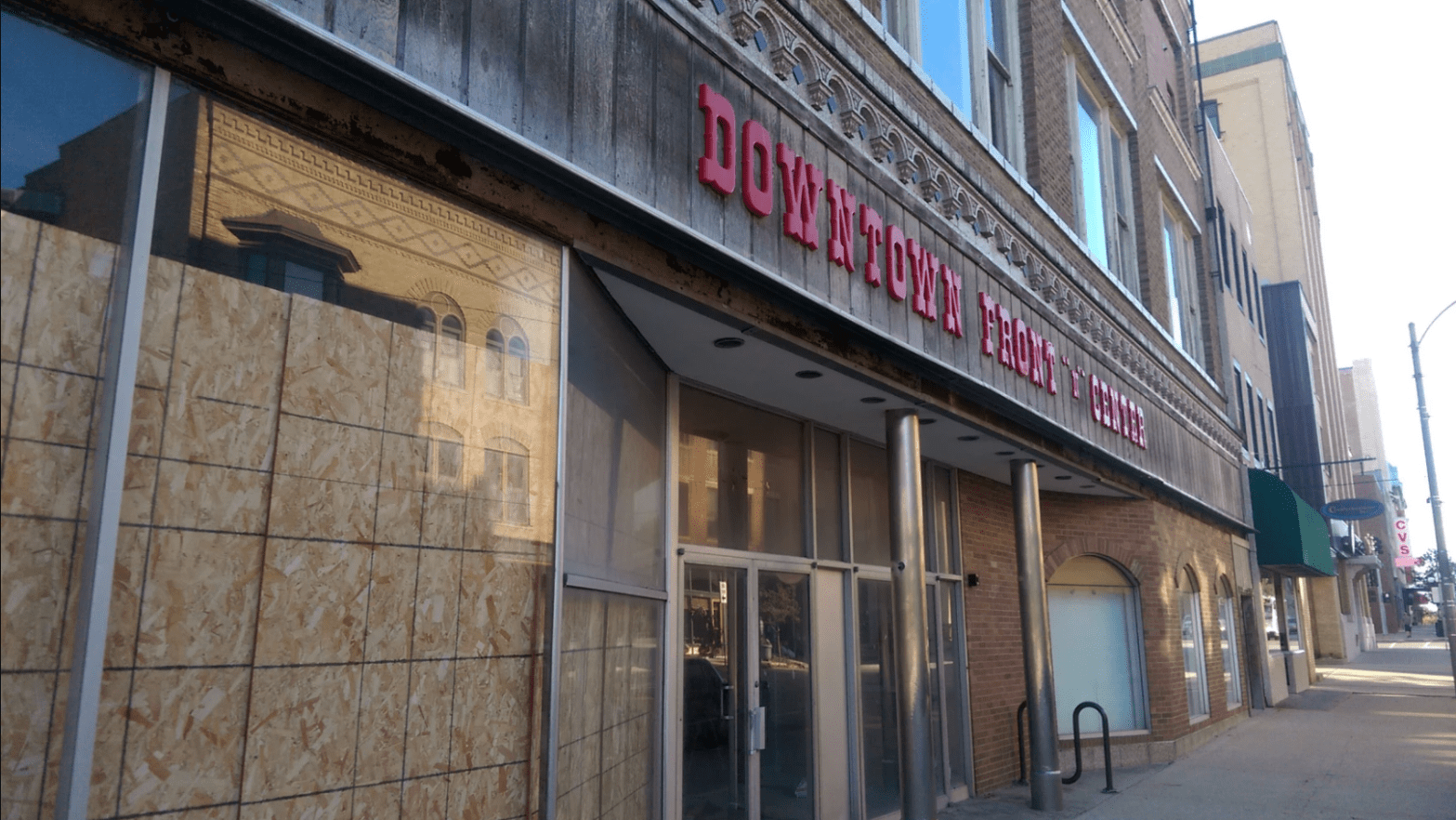

On Monday, several proposals will be brought before the Bloomington City Council to deliberate the futures of several landmark parcels in downtown. The Front N Center building, the adjacent DUI Countermeasures building, and the former Elks building across Madison Street will be slated for demolition due to horrible mismanagement by the out of town Huff family. Unfortunately, it seems that the Front N Center building especially is beyond repair for any developer who could feasibly take on the daunting project.
Without recourse, it looks like these historic structures will come tumbling down. To meet the downtown’s perceived parking needs, the city staff suggests that these three buildings be razed for 140 new surface parking spots. If this decision to construct a surface parking lot is permanent, it would be a generational fumble. Hopefully, as the city manager alludes to, this is not the final goal for the parcels.
This polemic will be against the suggested parking lots, not the housing project slated for the People’s Bank Building.
The Importance of Setting Standards–and Enforcing Them
The Front N Center building is emblematic of a civic culture that is steeped in apathy from officials and citizens alike. Community development expert Jeff Siegler of Revitalize, or Die puts it plainly:
Regulations exist to set community standards and protect investments. We have laws against theft and reckless driving for a reason. Property maintenance laws serve the same purpose—without them, investment becomes too risky. Who wants to renovate a building next to a crumbling, abandoned structure? No one. And that’s why money never flows into cities that tolerate neglect.
Ignoring the problem only makes it worse. When local governments fail to enforce existing laws, they send a message: Do whatever you want.
As a public school teacher, this is a lesson I’ve learned early on in my career. If I let behaviors slip, eventually even the best behaved kids in my classroom would be acting out since there were no consequences to doing so. If out-of-town owners like the Huff family can latch onto key properties for decades and let them rot, the signal that this sends to all other property owners is one of indifference: paint chips and it isn’t fixed, windows broken tend to stay broken, “hey, if they don’t care about this city, then why should I?” This is a toxic spiral that leads to the decay of our built environment. It doesn’t have to be this way.
To Wreck or Not to Wreck?
It seems that there are some within city hall that are quick to dismiss empty buildings to the wrecking ball. My first thought goes to the beautiful church building that is now the home of Song and Sword Church. The accounting that goes into the redevelopment process needs to be unveiled for the public to see more clearly. Not only do old buildings have charm that newer ones tend not to have, but according to Jane Jacobs, these buildings also allow for a varied marketplace in rental spaces.
When calculating the costs to redevelop, take a look at multiple possibilities through a parallel pro forma. Publish that pro forma, seek public scrutiny, request proposals, and perhaps maybe even create a standardized development/historic reuse incentive package that’s been discussed for years. This allows the process to be more transparent and allows for more opportunities to save and adapt buildings that are slated for destruction. After all, the greenest building is the one that is already built.

“Business-as-usual” Response
I have thumbed through reports on the conditions of the Front N Center building. It’s not pretty. The roof system has failed, asbestos everywhere, and the entire mechanical and plumbing system are shot. It would probably cost millions of dollars to bring the building to a livable condition, millions of dollars that I unfortunately do not have. That leaves the wrecking ball if the accounting does not add up.
The current proposal that will go before city council will create two new parking lots by the end of 2025. In a weird nod towards “preservation,” the northeast corner of the Elk’s Club facade would be preserved as a monument to the times we could actually build nice urbane structures.
Now, I see the reasoning behind the city staff’s decisions here. The Market Street Garage seems to be held together with duct tape and the hopes of the city attorney’s against insurance claims from the faulty structure. Construction on a new parking deck/Connect Transit station won’t commence until at least 2026, meaning the 550 parking spots there are quite fraught. Throw in the recent closure of a private parking garage on Jefferson and East, downtown residents are in quite a pickle for the next few years. (As someone who prefers not to use a car, I have to be understanding of folks who rely on those garages for their apartment parking to commute to jobs in office parks unfriendly to transit).
City Manager Jurgens said, “Looking ahead, we hope to develop a parking garage on the site, which would open up surrounding parcels for additional investment and growth.” This is another one of those “silver bullet” big project responses to temporary urban problems. Business-as-usual which would lead the city deeper into budget woes, as the national average to build a new parking garage is between $7.5 million and $12 million. Not only that, the city would have to pay annually to service the garage, and it would not be generating any tax revenue. (paid parking schemes almost never cover the costs of construction). Mind you, that an 800 stall garage would already be located less than 500 feet away. That is a shorter distance than most Americans travel from their parked cars to conduct their shopping at Walmart or Target. $12 million dollars of tax money to not have to walk an additional block downtown. Yay.
A Possible Strong Towns Response
If the buildings are truly beyond saving, then we must continue with a Strong Towns response. We’ve already covered the path to financial solvency in a previous article, but the gist is this: we must build iteratively, we must build to maximize taxes per acre, and we must build to nurture human flourishing. Our downtown needs to remain a destination and that cannot happen if more and more of the built environment is flattened for the placelessness of suburban-style developments. Perhaps that is a reason why historic preservation has gained so much traction in the United States, we are scared to see great buildings demolished because we know what will be replacing it will be more soulless architecture of nowhere. It does not have to be this way.
What makes our downtown great is its human scale, patchwork of unique properties with quirky personalities, and a wealth of places to allow us to grow and connect with each other. Therefore, we should replace these buildings with something more resilient.
I see a surface parking lot here as an unwelcome evil, but until the Market Street deck is replaced, I can allow it while a cohort of small developers can be gathered to be unleashed on this parcel.
One of the biggest flaws of the Front N Center building was its massive size and single ownership structure. It is too big for most downtown-style tenants and can lay empty for years while deteriorating. What should replace it should be akin to the structures along the 300-500 blocks of N Main Street. Relatively short street frontages, simple construction, flex space on the ground floors, and residential units above. There is a reason why this type of building is prevalent in all pre-war American (and global) downtowns. It made financial sense for both the proprietors and the municipality. The varied ownership and small lot sizes allows for a lowered bar to the rental spaces, local ownership, and a unique flair not bought through chain stores and suburban style five-over-ones.

Let’s also do the math here…The current Front N Center building was billed $19,733 in 2024, the DUI Countermeasures building was billed $1,966 in 2023, while the Elk’s Club building was billed $9,297 in 2023. The total acreage for all the parcels is calculated to be around .89 acres. Now, looking at the N Main St blocks, there are many buildings that pay more than $40,000 in taxes per acre. Specifically, Coffee Hound’s building pays more than $110,000 in taxes per acre. Let’s shoot for something more realistic, as all of the buildings proposed would be new, not over a hundred years old. I’ll put this, the city proposal, and the Strong Town’s Response in a chart:
| As-Is (2023) | Parking Proposal | Strong Towns Response | |
| Total Property Taxes Per Acre | $34,826 | $0 | $50,000-$100,000 |
We need to think big and outside of the box in Bloomington. Uncreative ideas lead to permanent parking craters that destroy the urban fabric. Restoring the rich and varied life of a downtown small parcel urbanism is the key to urban revitalization when historic reuse schemes fail.
Immediate Path Forward
In the meantime, I will be ensuring that this piece gets in front of city staff and council. Staff should crack open the accounting books and explain to the community the ins-and-outs of why historic reuse won’t pencil. If true, we should advocate for an eventual replatting of parcels and organize the people and funds to build something us locals should be proud of.
While there is a parking lot there, staff should ensure the space does not become dead like the lots east of Prairie Street. Put in kiosks. Allow food trucks. Expand the farmers market. Activate the space a-la Better Block, and prepare the public for what comes next: a better built environment and a downtown for everyone.
Discover more from Strong Towns Blono
Subscribe to get the latest posts sent to your email.
 Strong Towns Blono