

I had the pleasure of reading The University of Notre Dame School of Architecture Dean’s Charrette of Downtown Gary. Compared to our recently completed amateur Front N Center Design Charrette, this is the gold standard and professional quality.
Notre Dame has gained a national and international reputation of being an excellent purveyor of traditional architecture and urbanism, that is designing beautiful and walkable communities. This past year, faculty and students of the school worked with local stakeholders in the Rust Belt city of Gary, Indiana for new vision of Downtown Gary.
Gary is the quintessential Rust Belt city, when manufacturing closed up shop, the community hit a death spiral of population loss, concentration of poverty, and a kick in the gut for their civic pride. It is because of the problems of deindustrialization that Gary has multiple hundreds of decaying properties classified as “blight” for their deleterious effect on the nearby urban fabric.
The charrette team correctly determined that these blighted properties offer opportunities and value to the city, as their character and structure tells a rich history. They also realized the realities of economics that will prevent many of the structures from actually being saved. The team proscribes the building evaluation process below:

The decision tree above and the decision matrix below are used to gauge what to do with various abandoned properties in the community.
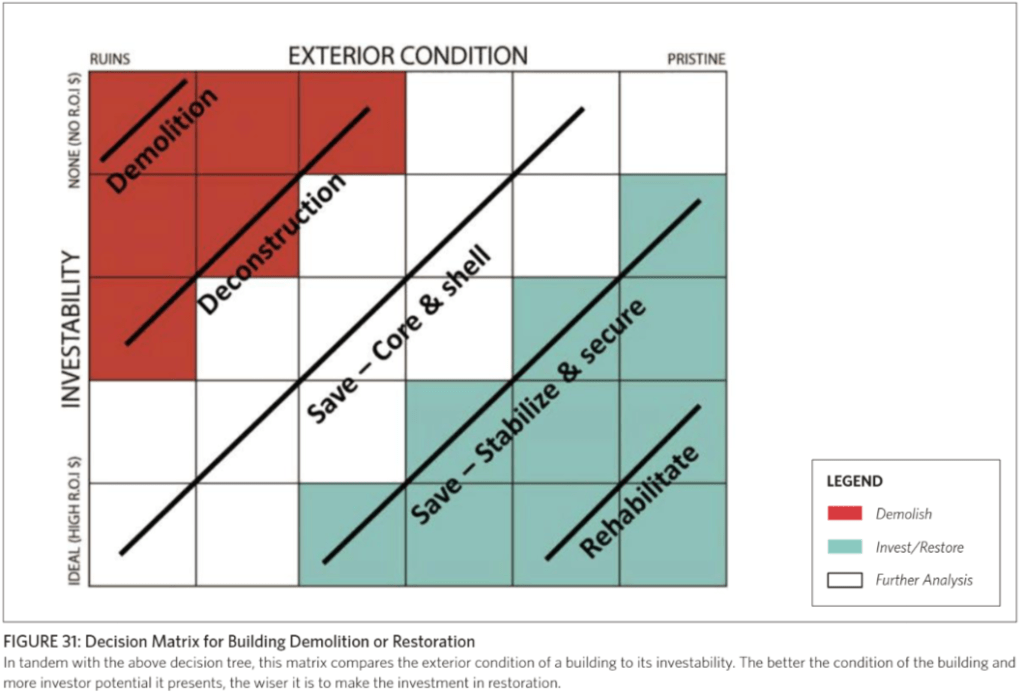
I’ve seen this successfully carried out in practice in different places: Providence, RI being a standout. Several buildings downtown were condemned and this process was followed. It was deemed the cores and shells of the buildings were not only architecturally significant, but also in operable condition. The interior of the building was deconstructed and turned into a parking lot while the shell was stabilized with steel supports in search for a developer down the line.

When applying this decision framework to our local context, the Historic Preservation Commission should not be the only actor involved in this process. Ideally, the city should be proactive in identifying buildings and parcels that are at risk of abandonment, work with owners on strict and recurring code enforcement to ensure that buildings do not get to the stage of decay that would require demolition or deconstruction.
Building code enforcement with actual teeth are the guardrails of a flourishing community. If bad owners are allowed to oversee the decay of their building, it is to the detriment of the rest of the block, the downtown, and the community as a whole. Just because it is private property does not absolve people of the duty to be a good steward, downtown property especially.
Another key to this culture of historic preservation that the Notre Dame charrette team highlighted was the importance of fostering careers in carrying out this process: material reclamation, historic carpentry, and brick masonry. They suggested high school training programs to be created to develop a pipeline of skilled craftspeople who can take on these tasks. With the Bloomington Career Academy moving into a larger space for the 2025-2026 school year, it would be an interesting proposition to train construction trades students in these skills.

Looking forward, our community will be facing the hard choices of historic preservation in the near future. In fact, we are seeing the architecturally significant Elks Lodge building’s façade being saved for future use. Perhaps we do the same as Providence and allow temporary murals to beautify the space while an investor is found.
Discover more from Strong Towns Blono
Subscribe to get the latest posts sent to your email.
 Strong Towns Blono