
This post will be slightly different from what we have previously posted on this blog feed. However, I think it is important to discuss the personal side of the housing crunch here in Bloomington-Normal. Life can change quickly and housing situations can go from secure to precarious in a matter of days. Embracing a time-tested housing strategy might be an answer for those who find themselves unable to afford their current living arrangements: roommates.
In 2021, I found myself stunned and divorced at the age of 26. Standing in my house alone, my American Dream to own a single family home seemed to fall apart without the family to fill it. Not only was I finding it difficult to process, but I realized I could not afford to stay. I thought back to the idea of thinking small to improve my situation. “What’s the smallest step I could do to make things better?” So I posted an advertisement on Craigslist to rent out my two extra bedrooms in order to keep my house. Having lived in town for a while, I understood that most landlords either offered year-long leases or leases tailored to the school years for students. Unfortunately, many young professionals and interns either could not afford market prices or their stays were too short to find a suitable apartment.
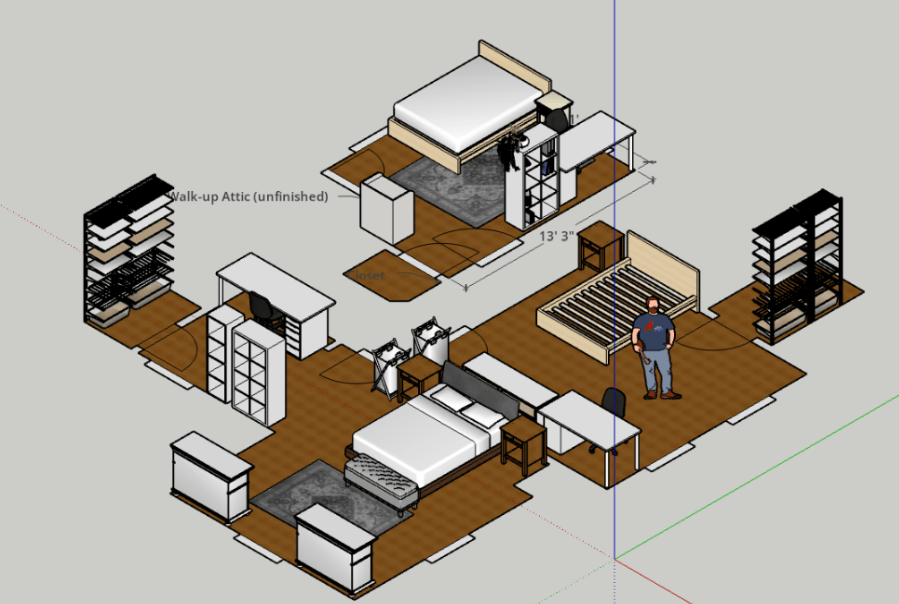
One of the rooms was already furnished, so a combination of Facebook Marketplace and an Ikea run helped furnish the other bedroom I planned to rent out. The future tenants would share the upstairs bathroom, while I was fine with using the shower on the first floor. In order to determine the asking rent, I just took my monthly mortgage payment and divided it by two. The average asking rent for a one bedroom in 2025 is $850, a studio $749. My going rate was around 60% of that.
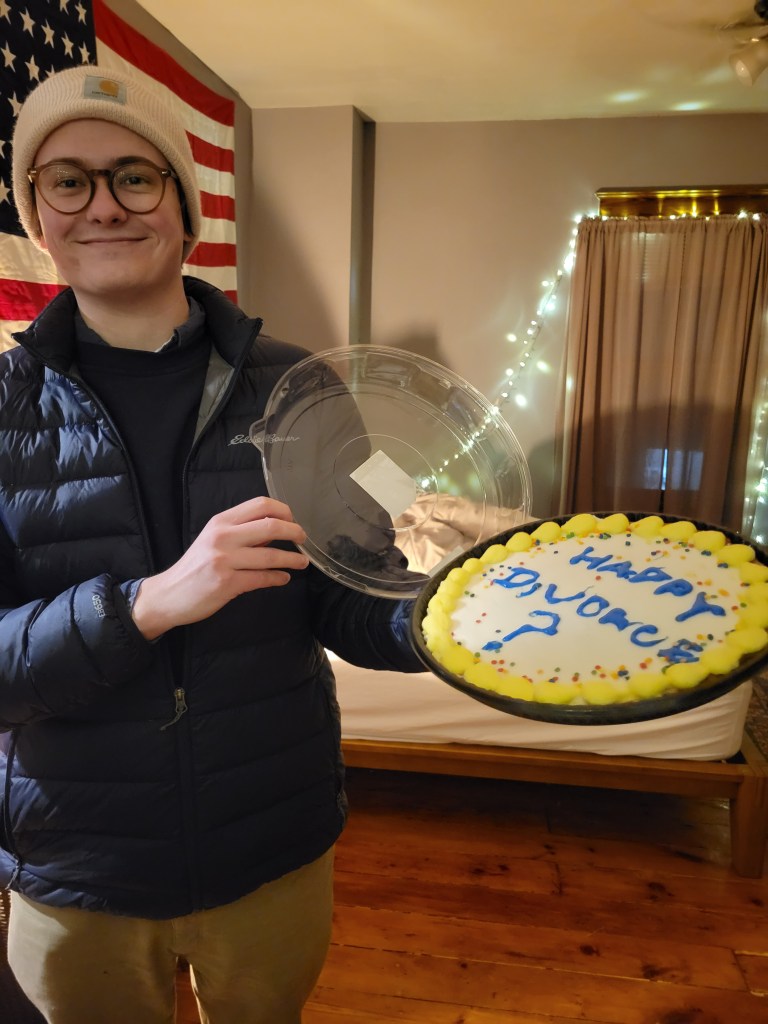
Not only did my solution help me pay my bills and build some savings, it gave me a sense of community to cope with my grief. Pictured above is one of my first roommates, Bailey, he was an intern at a factory in town and practiced his band’s music in my basement. Upon hearing that my divorce was finalized, he bought me an appropriate cake. Below is our whole house hiding in the basement during a tornado warning. It was Vikki’s first midwest storm experience, definitely different from her home in Hong Kong. My roommates cooked and ate meals together, went to concerts and baseball games together, had a shared household gym membership, and of course did chores together.

I am not saying living with roommates is all fun, or something everyone would be comfortable with. I did have to share a very vulnerable space with total strangers; we had to build trust with each other. In fact, Bailey told me that his first week in the house he not only locked his door, but shoved a chair under the doorknob when he slept. There was certainly conflict. My first roommate was quite an eccentric person, and the introduction of another person to the house led to him silently moving out and living somewhere else because he did not like doing “conflict resolution” regarding hygiene habits.

The shared space also took time and energy to talk out about what each person’s level of cleanliness was: I really disliked coming home and seeing someone else’s unwashed dishes in the sink, or random things left strewn about that had to be taken by their proper owner and returned to their storage space.
I housed six people over the past four years.That’s six units of housing freed up for other people who need it. Renting out my rooms in my house alone did not shift the housing market, but imagine if just a small portion of people rented a room or maybe even added another unit on their property. This would democratize the response to the housing crisis. Right now, the average household size in the United States is around 2.51 people. The average size of home is around 2496 square feet, much larger than it was in the past century. We have fewer people in larger homes on average, a way to alleviate some of the housing market pains would be to take on roommates or “boarders.”

There is a long historical precedent for taking on boarders in the United States, in fact according to the US Census Bureau, between 1900 and 1930 boarders made up about 3 percent of all household population. Right now, that number is around less than 1 percent. Back before the advent of the social safety net, like Social Security, a surefire way to ensure a retirement income was to take on boarders. Many widows rented out rooms in their homes to people in order to sustain themselves after their husbands died.

Even here in Bloomington-Normal, boarding was commonplace. Take a look at any old census document, and you’ll find the delineation “boarder.” Walk down Grove Street and take note of all of the historic markers, many of which discuss how houses had separate units built as extra income. It is not obvious, but once you have an eye for it, you cannot miss the signs of these “stealth” multifamily units: multiple mailboxes on a house, several electrical meters, or more than one front door. They have always fit right into our neighborhoods, in fact they were built alongside the rest of the homes. So when people argue that these small duplexes “go against neighborhood character,” I simply have to disagree.
Some people have asked why we as a country have moved away from having boarders in our homes, and I think the answer is rather simple. With the establishment of “Middle Class” norms of nuclear families in the years after World War II, having boarders inside your home was seen as a sign of being lower class, even if that meant the boarders were extended relatives. The American Dream called for the expansion of personal space and did not view the home as a place for “productive ownership” or as a way to make money. The nature of boarders themselves during this period definitely brought a stigma to the practice. Unmarried men and day laborers often brought their vices with them into these shared homes. Eventually many cities, including Normal, banned homes with several unrelated adults living in the same quarters for this and several other reasons.

In the future, I see the possibility of boarding, or “househacking” coming back into vogue as housing gets more expensive and as household size continues to shrink. Strong Towns is a major proponent of flexible missing middle housing solutions, and a developer/designer out of Texas, Monte Anderson has created a “Multigenerational Roommate House” that skirts around single family zoning limitations to allow a return to traditional housing patterns.
In fact, my own family has an arrangement very similar to this, as my grandmother lives in a locked-off suite from the rest of the house. She even has her own kitchenette.
Imagine that just a small portion of homeowners in Bloomington-Normal either took in boarders the traditional way like I did, or put in an internal suite in their homes to house people. There are 37,013 housing units in Bloomington and 21,879 in Normal, for a total of 58,892 units. If just 3% of people took in one person as a boarder, around 1750 more people would have a place to stay.
Lastly, a more permanent solution would be to re-legalize these missing middle units in all residential zones in the community. If a homeowner wants to have another unit on their lot for their aging parents or their college-aged kids, or even just to rent out, it should be their right to do so. Building neighborhoods like these ensures that people in all stages of life can afford to stay in the same area as they choose.
Whether it is taking in roommates due to a divorce, or renting out an extra unit for retirement income, allowing this type of housing flexibility is important to not only the resiliency of the homeowners, but also the housing system as a whole.
Discover more from Strong Towns Blono
Subscribe to get the latest posts sent to your email.
 Strong Towns Blono